19 February 2011

The Urethra Postcard Art of Gilbert & George at White Cube

We are the most disturbed people we have ever met”. This statement was carefully written, rewritten and signed by the artistic duo 13 times. Then the 13 postcards were arranged into a square with a single postcard in the middle, an arrangement they state symbolises the urethra and is a direct reference to Charles Webster Leadbeater, who incorporated the symbol into his signature. Leadbeater was a follower of Theosophy and an author on the occult; his career was also haunted by rumours of peadophilic crimes. This tickling of the line between provocative and shockingly inappropriate is typical of the pair’s work.
The majority of the postcards in the exhibition are not made by Gilbert & George; they are a collection of London’s touristic postcards and call cards, apparently collected from phone booths. Mesmerizing patterns formed by the composition of Union Jacks are juxtaposed with photos of a man’s tight backside and the curious advertisement: "i'll drag you round my posh flat by your nuts, you filthy vetch".
The deliberate combination of these two points of focus: the garish side of tourism and the sex market, blend to form a bizarre view of contemporary London. White Cube claims that Gilbert & George describe ‘with utmost clarity, poignancy and intensity, the unifying experiences of being alive in the modern world’. While it is impossible to claim that tourism and sex are not a part of our modern consumerist society there is little here for the common person to relate to. Audiences at White Cube explore the postcard collection, squealing with shock and delight at the explicit call cards, however I suspect that Urethra Postcard Art will not remain long in their minds, after they emerge from the Gallery back into pristine St. James’s.

The exhibition at White Cube, Mason's Yard closes on 19th February 2011.

10 February 2011

'La Tempesta' in Mime

Chocolate cakes and tape cassettes swinging from a washing line, a kangaroo wearing boxing gloves and dying clowns, an industrial robot and audacious nude performers, aerial acrobatics and melodramatic musical strains; these are just some of the theatrical treats enjoyed at this year’s International Mime Festival in London. The festival is difficult to typify. It is difficult, in fact, to typify what precisely mime is today; it seems that silence is no longer a prerequisite. Some of the performers in this year’s festival would look at home in the Cirque du Soleil, while others lack not only such acrobatic skill but also the concentrated physical control associated with traditional mime.
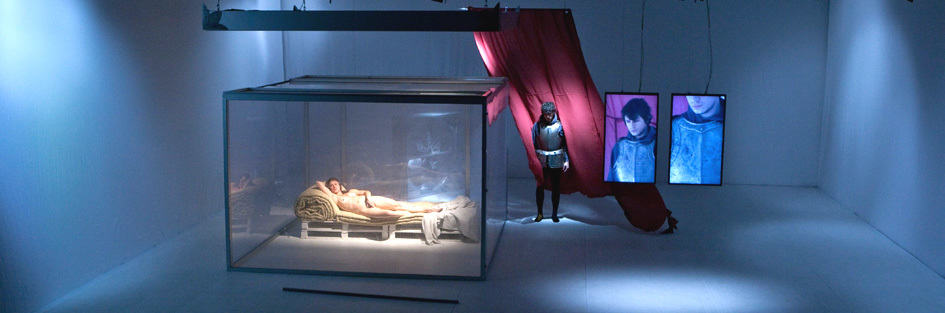
I went along to the ICA, to see the Italian duo Anagoor perform Tempesta. The company define themselves as a ‘theatrical project’. Tempesta took as a point of reference, and as a namesake, Italian Renaissance painter Giorgione’s work La Tempesta, although they make reference to several of his works.

During the performance, the two performers move slowly around the stage, traveling in and out of a large constructed glass box. They repeatedly dress and undress, emerging and disappearing in the mist created by a smoke machine. Layers are built in smoke, flesh, and cloth, alluding to the slow evolution of the painting process. In sparse moments of clarity the figures pause in the pose of a Giorgione figure. Playing on two portrait-shaped video screens are images of the performers; snippets of the outside world. The performers mirror their filmed selves as if willing themselves into this exterior reality. The ambiguity of their interaction recalls the ambiguity of Giorgione’s painting – the nature of its subject is still debated.
Mysterious or simply pretentious? Intense and atmospheric, or boring?  I would say that Tempesta occupies a grey space in-between these labels. Such an enigmatic nature welcomes personal interpretation with open arms. But it also risks not conveying any message with conviction.
Tempesta uses theatre to recreate a painting and one must ask the question: why? Watching Tempesta is indisputably a very different experience to sitting in front of a painting for an hour but there is a niggling sense that, in spending so long exploring the nuances of Giorgione’s artworks, Anagoor have forgotten to relate it to their own world; consequently the themes and issues engaged with in Tempesta lack the bite of the contemporary.

Anagoor are on tour in Italy until the 20th February.

15 January 2011

Crooning and Milling at Late at Tate Britain

Perhaps my visit to Late at Tate Britain was doomed from the start. On a damp and blustery, January evening I coaxed my cynical (yet ever obliging) boyfriend off the sofa and out onto the London Art Scene. He is neither a lover of art nor, with the exception of myself, of those who love art. So when, on disembarking from the long bus journey down from North London and finding that this particular evening does attract 'that particular kind of art-lover’ – there were white leather jackets, thick-rimmed glasses and geometrically printed leggings-a-plenty, I suspected we were not in for the best of nights. 


I have been to a fair few evening events in galleries, but Late at Tate has remained unique.  Most galleries open their doors for the odd evening, to allow those soles, too busy during normal opening hours, a chance to peruse their collection. It is also common for galleries to hold talks, show films or have poetry readings on these nights. But Tate Britain is something different; the entire gallery is transformed in to a social space. Normal gallery etiquette is abandoned as the lights are dimmed and the drinks are brought out.

During this particular Late there were displays of performance art, in the form of spoken word and a puppet show, there was a DJ and several live music performances. The hoards milled, floating between rooms plunged in tinted light, catching the odd word or idea, whilst nursing the neck of their bottle of Italian beer and crooning at their fellow millers.

Bravely we penetrated the crowd and broke to the front of a semi-circle that had formed around a man with a microphone. He spoke his lyrical lines with fluent rhythm yet we were at a loss as to what he was talking about. The Tate has left this artistic space open and fluid – there are no seats, no signs informing about performance times, as in the open collection visitors feel encouraged to browse – to stop and consider a work for a couple of minutes and then move on.

In the DJ room (formerly Painting: 1550-1880) the lights were dimmed to such an extent that is was difficult to see that there were frames on the wall at all, let alone what was in them. So what you have is a large, dimly lit room, with people socialising and drinking overpriced drinks while a DJ goes largely unnoticed. Apart from a lack of seating, I was hard-pressed to identify what makes this different to any other London bar. 
The performances may well have had their merits, however I feel this confused space only detracts from any power they might have. As much as I like the idea of exploring a gallery with a chilled beverage in my hand, I also require a practical amount of lighting. I think I’ll stick to daytime visits for now.

07 January 2011

The Museum of Everything Peter Blake

The success of The Museum of Everything's last exhibition has led to its reopening, generously allowing you five more weeks to experience the world of Peter Blake. This review was originally published in the Arts section of the November edition of MouthLondon magazine.

Snuggled in amongst the gastro-pubs, the mock bohemian coffee shops and the learn-to-stitch (-and-bitch) studios on the picture perfect postcard streets of Primrose Hill the Museum of Everything awaits discovery. In this, Exhibition #3, the Museum’s founder, James Brett has collaborated with the innovator of British Pop Art and renowned collector: Peter Blake. The exhibition presents, for the first time, the outcome of Blake’s lifetime habit of collecting objects of his own fascination. It is a unique insight into the mind of the artist and will surely prove fascinating for anyone with an interest in his work. 
Illustration by Abi Daker

The warehouse-style space, a former dairy, has been constructed into a network of corridors, small intimate rooms and a large hall; these spaces intertwine and span two levels in a way that will confuse your orientation but also achieves the sense of exploration they were surely going for. The spaces are pieced together from stripped wood, nails and the odd splash of paint. The interior aesthetic draws a sharp contrast to the affluent neighborhood it is situated in and also to the typical visitor. However, it is fitting with the content in that it represents the haphazard collecting of an artistic mind.

The walls are adorned with posters and photographs of circus and music hall entertainers, carnival memorabilia is arranged on a fake grass turf and cabinets are filled with collections of dolls, puppets, taxidermy, boxes covered in shells and paper flowers. These objects if encountered singularly would be likely to be considered in bad taste, kitsch even. However, in mass-quantities Blake’s objects speak of the one common detectable theme that unites them – mass popular entertainment and production, mostly from the 19th Century. It is unsurprising that Blake’s collection can be related to popular culture given this is the genre of his life’s work – some of his most well known artworks have been record sleeves, for bands such as the Beatles and The Who, and he often used cultural icons and logos. 

This multifaceted exhibition is being presented, by the Museum of Everything, as a singular piece of installation art. However this proposal is problematic. Peter Blake was quoted by journalist Helen Sumpter, three weeks before opening as saying: 
"In a way it's a conceptual art piece, we're just not quite sure what the concept is yet."
And although there is a sense of unity to the collection the lack of accompanying literature suggest a lack of thought; perhaps they never figured out the ‘concept’. 

There are implications to many of the objects in this exhibition, for example gollywog dolls and images that suggest the exploitation of so called ‘freaks’. Given the presentation of the objects within an environment that plays upon the art worlds’ fascination with the chaotic creativity of the artist and contemporary societies tendency to romanticize the past, and without providing any additional critique of the objects it would seem that the Museum of Everything is taking historical spectacles and transforming them into spectacles for the modern day. Yet, acknowledging this you cannot dispute the Museum of Everything’s ability to be on-trend and there is much to discover and enjoy in this diverse collection.

Exhibition #3 will be running until the 13th February.

29 December 2010

Open your mind and absorb the sentiment: Walid Raad at Whitechapel

On entering Walid Raad: Miraculous Beginnings you will be met by a spidery diagram sprawling high and wide across the wall: a graphic explanation of the  Atlas Group. The Atlas Group is a fictional collective that is building an archive of fake documents that form a history of the oh-so-real Lebanon. A little confused? I was.
This exhibition presents the composed documentation of Walid Raad and his invented personalities. Apparent archives of life in Lebanon, lovingly collected and arranged and then, by chance, inherited by the Atlas collective. The works insight far more than the information they claim to order; they reveal minds infested with the same concern for humanity in times of trouble. A city profiled by a network of like-minded individuals who are simply trying to come to terms with the horrors of war; to give a semblance of structure in the midst of chaos. Individuals who are similarly (conveniently?) aesthetically driven. And although no hands could be raised in answer to a calling register of these names they exist in the mind of Walid Raad and in his mindful conception of the city of Beirut, given to us here, in the realised form of colour and film, photo and lettering. Is this practice deceitful, does it need to be reconciled?
Entering the gallery you are soon drawn to a video the other visitors are circulating around – Hostage: The Bachar Tapes (#17 and #31) (2001). It is a visual document of Souheil Bachar’s enforced captivity in Lebanon, during the years 1983 to 1993. The film is fascinating; shocking, enthralling, titillating. Fictional. You wonder what exactly you just spent 18 minutes experiencing.

Raad certainly does demand a great deal of thought from his viewers and you get the impression that much of his works’ content will fly over the heads’ of visitors to this exhibition, but is that part of the point? Raad’s mixed media art is engaged with the swirling throng of media that surrounds and informs us everyday. This involvement produces a critique by casting doubt on the authority of the media's document.
Furthermore, Raad’s art strives to capture a spirit. In a new approach to the formation of a history, his art declares: we can never know the whole and real truth, so why try. These events may have not occurred, but does that matter? Many events that did occur are left undocumented or are incorrectly recreated in print and image. The tales spun by Raad’s archive are comparable to mythical stories that tell real life lessons. They may be fictional, but you would never hold that against a novel. This is Art.
Whitechapel has not gone out of its way to clarify the complexities of Raad’s work. I approached this exhibition, as many will, with a certain degree of ignorance about the Atlas Group and background reading was required before I felt that I had even reached an understanding of what Raad is attempting. Some will see this as a curatorial failure others will argue it is a trait, or perhaps even a flaw, in Raad’s work. Either way, if you decide to visit this exhibition do be prepared for something taxing. But, open your mind and absorb the sentiment and you will find something ultimately insightful.


The exhibition continues until the 2nd January.

07 December 2010

James Turrell at the Gagosian Gallery

There are just a few days left now to check out James Turrell at the Gagosian Gallery in King Cross and I can not recommend it enough. 

The exhibition features Turrell’s recent installations, sculptures and prints that play with light and space. The centerpiece is his interactive installation 
Dhatu (2010)
and is the one the hoards have been queuing around the gallery for, every weekend for the last few weeks.
When you have waited your turn and performed the ceremony of removing your shoes and donning plastic feet covers that make you feel like you are preparing to enter a new dimension, the smartly suited gallery attendants direct you to ascend the staircase and cross the threshold into the installation. The interior is large, although the dimensions not initially obvious. Beyond the end of the room there is a seeming infinity of light that bathes the white walls and the space all around you in an ethereal haze that confuses your space perception.
Turrell’s installations are all about contemplation and self-discovery. He creates spaces that demand complete immersion; sanctuaries from reality. Dhatu evokes ideas of a space after death, or before birth, a dream world or a non-space where nothing is determinable. Looking back on the outside space, from within, the real world is no longer recognisable – the changing colour within the installation creates an optical illusion that makes the exterior gallery space seem similarly immersed in alien colour. This emphasises the feeling of isolation and creates a sense that things will never be the same again. 
Turrell has been using the combination of light and space as an artistic medium for more than forty-five years. In this installation he manipulates light in a way that transcends its everyday use; the light gains a physical presence that boarders on the oppressive. Light is not only the medium but also the subject of his art. Turrell studied perceptual psychology during the 1960s and continues to explore the possibilities of perception created through the interplay of light and space.


Immerse yourself in Dhatu at the Gagosian Gallery, until the 10th December.

03 December 2010

Shadow Catchers: Camera-less Photography at the V&A

The five artists, exhibiting in Shadow Catchers: Camera-less Photography at the V&A museum, have not chosen straightforward careers for themselves. Their work is caught in a limbo between photography and painting; art and craft; acceptance and disregard. The lowly lit exhibition space swathed in black is reminiscent of a dark room and indicative of their purgatory from the mainstream.

There is much variety within this little exhibition; the binding aspect of these artists’ work appears to be the minority status of their medium. This serves to provide an interesting cross-section of what it is possible to do without a camera. The various techniques employed by the artists will mystify the greater part of visitors and this shrouds the works in the enigmatic power of the unfamiliar. 
The work of Floris Neusüss and Adam Fuss tends towards a material form, taking inspiration from art, photographic and cultural histories; many of Neusüss images are figurative – impish silhouettes of svelte females, while Fuss projects concrete forms with spiritual or personal meanings. Pierre Cordier and Garry Fabian Miller’s work are more evocative of intricate scientific photography. Cordier specifies that his images are ‘fake photographs of an imaginary, improbable and inaccessible world’, however they have the abstract flavour of photos taken under a microscope. Fabian Miller has produced empirical studies that explore the connection between nature and light, such as a series of petals that gradually progress from ephemeral traces into vivid form. Susan Derges blurs the boundaries between the scientific document and the artistic with her seemingly abstract underwater images.


At the centre of the exhibition is an informative film playing on loop. Each artist was given a few minutes to talk about his or her work. In varying ways each artist stresses that their images do not represent the real; that they are not documents. This assertion is a symptom of the controversial position of these artists’ work within the much-debated field of photography as art. I am not denying that photography is largely accepted as an artistic medium, however, what these artists are doing is different and issues arise with the inevitable task of categorisation; Cordier strives to be acknowledged as a painter, being repeatedly denied this title and refusing ‘photographer’ he jokingly settles for 
‘faux-tographer’. 
These artists have taken the mechanical out of photography, hereby negating one of the original arguments against photography as art, and by incorporating painterly elements into the development process it could be argued that they have successfully fused the two mediums. This would horrify particular bygone photographers and painters alike. However, in many cases, the artist is still withdrawn from the image making process; some of these works are truly made by nature’s hand, and so the argument of photography as document still applies.

What these five artists are doing is not new; Pierre Cordier was a contemporary of Brassaï, but the fact remains that there are few, nay no, well known Camera-less Photographers. A surprising fact given that some of these artists have successfully engaged with contemporary artistic discourses, such as minimalism, and given the incredibly broad definition of art today, which can range from oil painting to a man cooking Indian food, it seems that the only thing thus far missing is a receptive audience…  

The Exhibition runs at the Victoria and Albert Museum until the 20th February 2011.